STOP AUDIT FAILURE: The 5 Critical Mistakes Your Team Makes in Pressure Calibration email us today info@addit-metrology.com

📈 Beyond the Number: What Do You Really Do With Measurement Uncertainty (MU)?
What to do with Uncertainty
Bradley Hemple
11/4/20252 min read

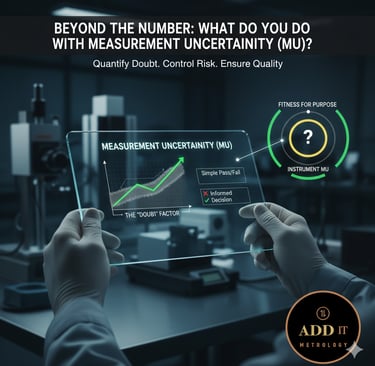
You've successfully deciphered your calibration certificate, noted the "As Found" and "As Left" data, and even checked the next calibration due date. But there's a line item that often gets a quick glance before being dismissed: Measurement Uncertainty (MU).
Many see it as a complex, academic number, but in reality, understanding and applying MU is crucial for making informed decisions about your process, product quality, and compliance.
Why MU Is More Than Just a Number:
It Quantifies Your Doubt (and Risk!): Every measurement has some inherent doubt. MU is the scientifically rigorous way to quantify that doubt. It tells you the range within which the true value of your measurement most likely lies. Ignoring it means you're operating with an unknown level of risk.
Determines "Fitness for Purpose":
An instrument might "pass" calibration (i.e., its "As Left" reading is within its stated accuracy specification), but its associated MU could make it unsuitable for your specific process.
Example: If your process requires a temperature measurement to be accurate to ±0.1°C, but the calibration certificate shows the instrument's MU is ±0.08°C, you have very little margin for error. In fact, if your process tolerance is tighter than the instrument's MU, you're essentially guessing.
The Key to Test Uncertainty Ratio (TUR):
Many quality standards (like ISO 17025 for labs or internal corporate quality systems) mandate a specific Test Uncertainty Ratio (TUR).
TUR = (Tolerance of the Unit Under Test) / (Measurement Uncertainty of the Calibration)
A common requirement is a 4:1 TUR or greater. If your TUR is too low (e.g., 2:1), it means the calibration itself isn't precise enough to confidently declare your instrument "in tolerance" for your application. This can lead to costly false accepts or false rejects.
Optimizes Process Control & Reduces Rework:
By understanding the MU of your critical measurement points, you can set more realistic process control limits.
This helps prevent "good" product from being rejected (false rejects) or "bad" product from being accepted (false accepts), saving significant costs in rework, scrap, or even product recalls.
Strengthens Your Audit Defenses:
Auditors, especially in regulated industries, are increasingly scrutinizing MU. Demonstrating that you understand and apply MU in your decision-making shows a high level of metrological sophistication and robust quality control.
Don't Just File It – Use It!
Ignoring Measurement Uncertainty is like driving a car without knowing how accurate your speedometer is. You might think you're going 60 mph, but are you sure you're not actually going 65 mph or 55 mph? That uncertainty has real consequences.
Instead, use the MU from your calibration certificate to:
Validate instrument selection: Is this instrument truly precise enough for its task?
Set appropriate guard bands: Implement tighter internal process limits to account for MU, ensuring your product is always within its final specification.
Optimize calibration methods: Work with your calibration provider (like ADD IT METROLOGY) to understand how to reduce MU where it's critical.
What's your biggest challenge in understanding or applying Measurement Uncertainty in your daily operations? Share your thoughts!
Training
Ready to enhance your team's pressure metrology expertise?
Contact our training specialists today to discuss your specific requirements, inquire about course schedules, or request a detailed proposal for customised training.
Consultation
info@addit-metrology.com
+44 7498 956 496
© 2025. All rights reserved.